
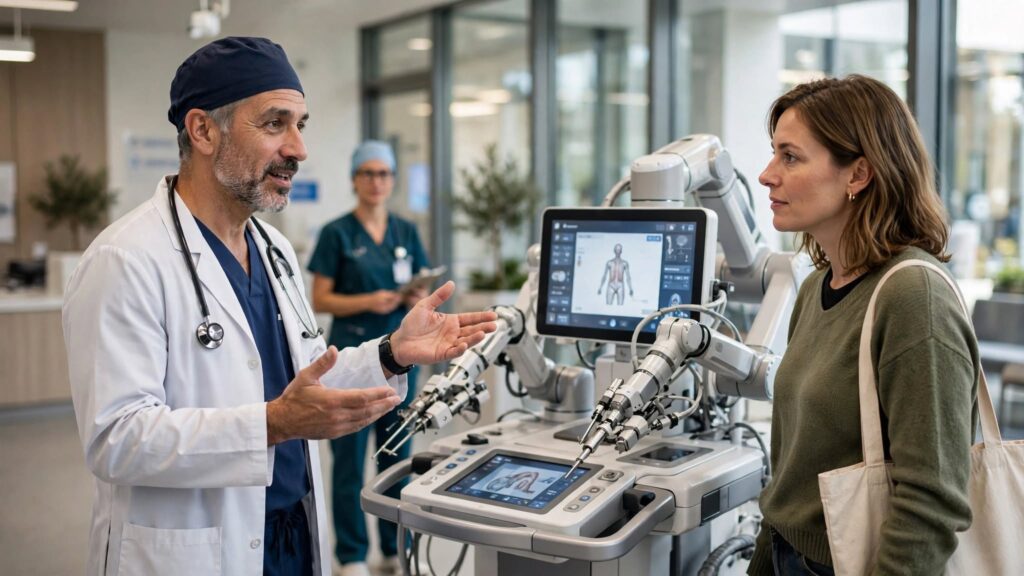
Robotic surgery can sound futuristic. The image many people have is of a machine operating on a patient while a surgeon watches from a distance. That is not how modern robotic-assisted surgery works.
In reality, robotic surgery is a surgeon-controlled form of computer-assisted surgery. A trained surgeon uses a specialized system to control surgical instruments and a camera, often through small incisions. The technology can provide enhanced visualization, instrument dexterity and control during certain minimally invasive procedures, but the surgeon remains responsible for the operation.
That distinction matters when you are researching treatment options. Robotic surgery can offer meaningful advantages for selected procedures, but it is not automatically the best choice for every patient. The right approach depends on the condition being treated, the specific procedure, the surgeon’s experience, your overall health and the capabilities of the hospital.
This guide to understanding robotic surgery explains what it is, how robotic surgery works, its potential benefits and risks, the procedures that may use it, recovery expectations, and the questions worth asking before making a treatment decision.
Medical disclaimer: This article is intended for general educational purposes and is not medical advice. Surgical decisions should be made with a qualified healthcare professional who has evaluated your individual condition, medical history and treatment options.
What Is Robotic Surgery?
Robotic surgery is a surgical approach in which a trained surgeon controls specialized instruments and a camera through a computer-assisted robotic system. The system is commonly used to perform minimally invasive procedures through small incisions. It can provide enhanced visualization and instrument movement, but it does not independently decide how or where to perform surgery.
The term robot assisted surgery can therefore be slightly misleading. The equipment assists the surgeon; it does not replace the surgeon.
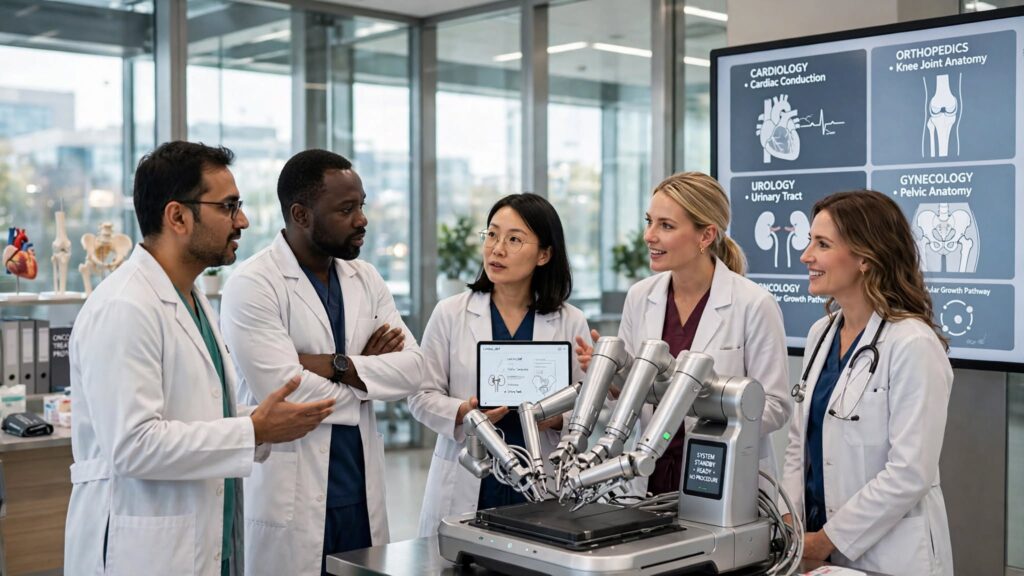
Many robotic-assisted surgical systems include a surgeon’s console, a bedside cart containing robotic arms and instruments, and an endoscopic camera. Depending on the system and operation, the surgeon can view a magnified image of the surgical field and control the instruments from the console.
Robotic-assisted surgery is used in a range of specialties. The FDA lists cleared uses for robotically assisted surgical systems in areas including general, cardiac, colorectal, gynecologic, head and neck, thoracic and urologic surgery. Examples include selected hysterectomies and prostatectomies, among other procedures.
Is Robotic Surgery Performed by a Robot?
No. The surgeon performs the operation and directly controls the robotic system.
The technology translates the surgeon’s hand movements into movements of the surgical instruments. This allows the surgeon to work through small access points and use articulated instruments in areas where conventional instruments can be more difficult to maneuver.
This also means that the quality of the surgical team remains critically important. A sophisticated system cannot replace clinical judgment, appropriate patient selection, surgical skill or good postoperative care.
How Does Robotic Surgery Work?
Understanding the technology becomes easier when you look at the procedure step by step.
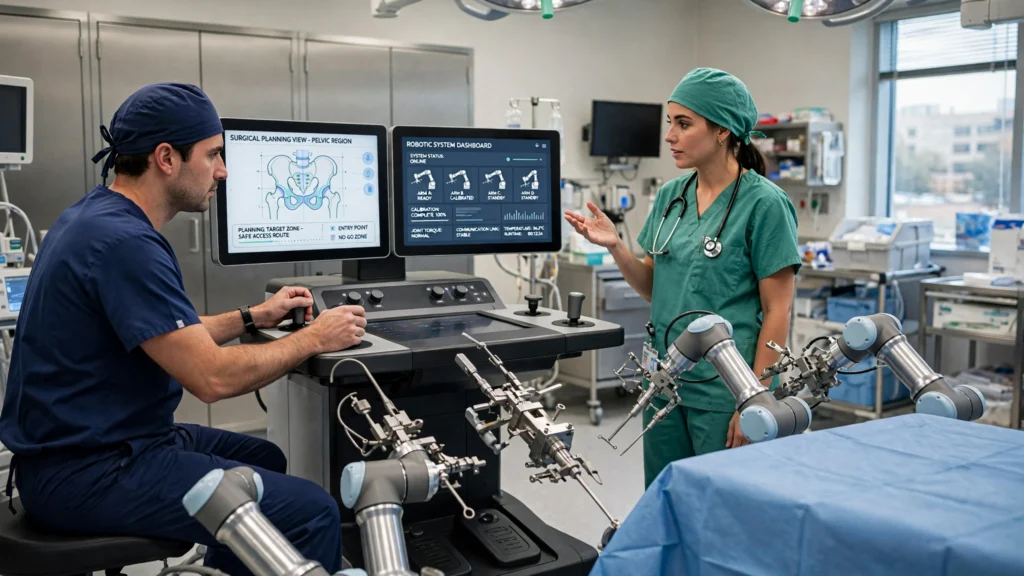
1. The surgeon evaluates the patient and plans the procedure
Before surgery, the medical team reviews the diagnosis, imaging, medical history and planned operation. Robotic assistance is considered only when it is appropriate for the specific procedure and patient.
2. Small incisions are created
For many robotic procedures, the surgeon works through several small openings called ports. The exact number and location vary according to the operation.
3. A camera provides a magnified view
A small endoscopic camera is inserted through one of the ports. Many robotic systems provide high-definition, three-dimensional visualization, allowing the surgeon to see the operative field in detail.
4. The surgeon controls the robotic instruments
The surgeon sits at a console and uses hand controls to direct the instruments. The robotic arms move according to those commands. The surgeon is not simply supervising an autonomous machine.
5. Articulated instruments assist with delicate movements
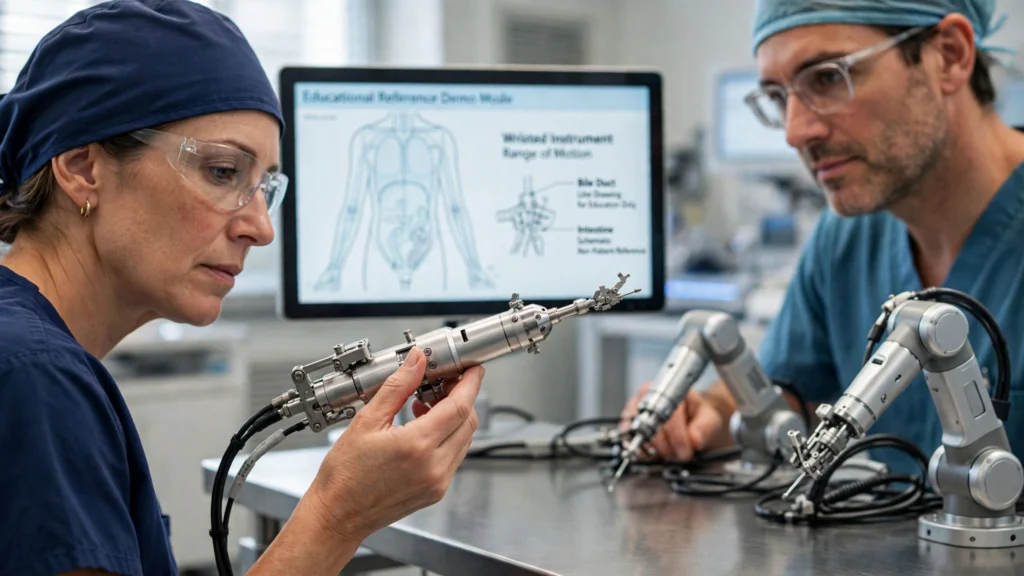
One of the technical attractions of robotic-assisted surgery is the ability of certain instruments to articulate and rotate in ways that conventional straight laparoscopic instruments cannot. This can be particularly useful in confined anatomical spaces.
6. The surgical team remains at the patient’s side
The operating room does not become empty while the surgeon uses the console. A bedside team assists with positioning, instruments, anesthesia and other aspects of the operation.
The result is still surgery performed by a human medical team, with robotic technology serving as a tool.
Is Robotic Surgery the Same as AI Surgery?
No. Robotic surgery and autonomous artificial intelligence are not the same thing.
A robotically assisted surgical system can help a surgeon control instruments and visualize the surgical field, while the surgeon continues to make the clinical decisions. The FDA specifically notes that robotically assisted surgical devices cannot perform surgery without direct human control.
This distinction is increasingly important because the terms “robotic” and “AI-powered” are sometimes used interchangeably in popular discussions. Patients should ask exactly what technology is being used and what role it plays in their specific procedure.
Robotic Surgery vs. Laparoscopic Surgery vs. Open Surgery
Robotic surgery is generally considered a form of minimally invasive surgery when the operation is performed through small incisions. Traditional laparoscopy also uses small incisions and a camera, while open surgery generally requires a larger incision to access the surgical area.
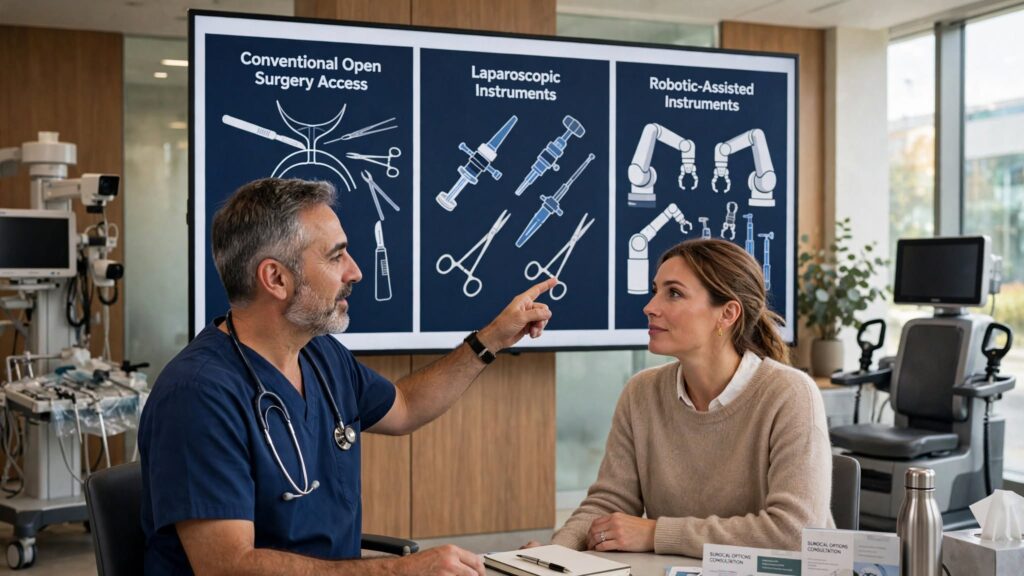
| Feature | Open Surgery | Laparoscopic Surgery | Robotic-Assisted Surgery |
|---|---|---|---|
| Incisions | Usually larger | Small | Small in many procedures |
| Visualization | Direct surgical view | Camera-based | Enhanced camera-based visualization |
| Instrument movement | Conventional | Usually straight/rigid | Articulated robotic instruments |
| Surgeon control | Direct | Direct | Direct through console controls |
| Minimally invasive | Usually no | Yes | Often yes |
| Potential recovery advantage | Procedure dependent | Often shorter than open surgery | Often shorter than open surgery in selected procedures |
Robotic Surgery vs. Laparoscopic Surgery
Both approaches can be minimally invasive, but robotic systems can address some technical limitations associated with conventional laparoscopy. Robotic platforms may combine three-dimensional visualization with articulated instruments, giving surgeons greater freedom of movement in certain confined areas.
That does not mean robotic surgery automatically produces better patient outcomes in every operation. Evidence varies by procedure.
Robotic Surgery vs. Open Surgery
Compared with open surgery, minimally invasive robotic approaches can offer smaller incisions and may reduce blood loss, postoperative pain and hospital stay in selected operations. However, the degree of benefit depends heavily on the particular procedure and the patient.
A 2024 overview of 165 systematic reviews found that evidence for robotic-assisted surgery was generally positive or neutral for many outcomes compared with open and laparoscopic approaches, while operative time tended to be longer and the evidence quality was often limited by weaknesses in the underlying observational research.
In other words, robotic surgery should be evaluated procedure by procedure – not as a universally superior form of surgery.
What Are the Benefits of Robotic Surgery?
When appropriately selected and performed by a trained surgical team, robotic surgery can offer several potential benefits, particularly when it enables a minimally invasive approach.
Smaller Incisions
Many robotic procedures are performed through small incisions rather than a large surgical opening. Smaller incisions can mean less disruption of surrounding tissue and smaller scars.
Enhanced Visualization
The surgeon may have a magnified, high-definition, three-dimensional view of the surgical field. This can help with depth perception and visualization of small anatomical structures.
Greater Instrument Dexterity
Robotic instruments can articulate and rotate within the body, which can make some technically demanding movements easier than they are with conventional laparoscopic instruments.
Potentially Less Blood Loss and Pain
In selected minimally invasive procedures, robotic surgery may be associated with lower blood loss and less postoperative pain compared with open surgery.
Shorter Hospital Stay and Recovery
Some patients can leave the hospital sooner and return to normal activities more quickly after minimally invasive surgery. However, robotic surgery recovery varies substantially by procedure, so there is no universal recovery timeline.
Ergonomic Advantages for Surgeons
The console-based design can allow surgeons to work in a seated position while controlling instruments with precise movements. That does not directly guarantee a better patient outcome, but it is one of the technological features that has helped expand robotic-assisted surgery.
What Are the Risks of Robotic Surgery?
Robotic-assisted surgery carries the normal risks associated with surgery and anesthesia, and it also introduces technology-specific considerations.
Potential complications may include:
- bleeding
- infection
- injury to surrounding organs or tissues
- complications related to anesthesia
- blood clots
- nerve injury or positioning-related problems
- technical or equipment malfunction
AHRQ’s Patient Safety Network notes that robotic procedures can introduce risks related to the equipment itself in addition to the risks already associated with conventional surgery. Surgeon experience and training are also important considerations.
Can Robotic Surgery Be Converted to Open Surgery?
Yes. In some cases, a surgeon may decide that converting to an open procedure is the safest or most appropriate way to complete the operation.
This may be necessary because of unexpected anatomy, bleeding, scar tissue, difficulty completing the procedure minimally invasively or other circumstances encountered during surgery. Conversion is not necessarily a complication; sometimes it is a deliberate safety decision.
Why Does Surgeon Experience Matter?
Robotic technology is a tool, and outcomes depend on much more than the equipment itself. Training, experience with the specific procedure, hospital resources and the broader surgical team’s expertise all matter.
The FDA recommends that patients ask their healthcare providers about the surgeon’s training and experience with robotically assisted systems.
What Types of Procedures Use Robotic Surgery?
Robotic-assisted surgery is used across several specialties, but the exact procedures available vary between hospitals and surgical systems.
Robotic Orthopedic Surgery
Robotic assistance is increasingly used for selected orthopedic procedures, particularly certain joint replacement operations. The technology can help surgeons plan and execute aspects of an operation with computer-assisted guidance.
Patients exploring advanced orthopedic options can learn more through TraveCure’s robotic-assisted orthopedic surgery services linked from its Orthopedics page.
Robotic Heart Surgery
Robotic systems can be used in selected cardiac operations, including certain minimally invasive valve repairs and bypass procedures. These operations require highly specialized cardiac surgical teams.
TraveCure currently highlights robotic-assisted cardiac surgery as part of its advanced cardiology services.
Robotic Neurosurgical Navigation
Not every technology described as “robotic” in neurosurgery is a robotic surgical arm performing the operation. Some systems focus on image guidance, navigation and precise positioning.
That distinction is important when researching advanced neurosurgical care and navigation technologies.
Robotic Urologic Surgery
Urology is one of the specialties in which robotic-assisted surgery has become particularly established. Procedures can include robotic prostatectomy and selected kidney operations. The FDA specifically lists prostatectomy among procedures that may involve robotically assisted systems.
For patients researching treatment options, TraveCure’s robotic urologic surgery services include robotic prostatectomy and selected kidney procedures.
Robotic Surgery for Cancer
Robotic-assisted surgery can be used for selected operations involving patients with cancer. Examples can include certain prostate, colorectal and gynecologic cancer operations.

However, an important distinction should not be overlooked: the surgical robot itself is not a cancer treatment or a cure for cancer.
The FDA states that no robotically assisted surgical device has been authorized in the United States specifically for preventing or treating cancer. RAS devices may nevertheless be cleared for certain surgical procedures that are performed in patients with cancer, such as prostatectomy, hysterectomy or colectomy.
Patients considering robotic cancer surgery should therefore focus on the underlying cancer treatment plan, the goals of surgery, the surgeon’s expertise and the available alternatives—not just the technology used.
Robotic Gynecologic Surgery
Robotic-assisted gynecologic surgery may be used for selected procedures involving the uterus and other pelvic structures. Depending on the condition, procedures may include hysterectomy or removal of certain fibroids.
TraveCure’s robotic gynecologic surgery offering highlights minimally invasive treatment options for selected gynecologic conditions.
Who Is a Candidate for Robotic Surgery?
There is no single checklist that makes someone a “robotic surgery candidate.”
A surgeon typically considers several factors:
The Condition and Planned Procedure
Some operations are well suited to robotic assistance, while others may be better performed through conventional laparoscopy or open surgery.
Overall Health
Heart and lung function, medications, previous operations and other medical conditions can affect surgical planning.
Anatomy and Previous Surgery
Scar tissue, unusual anatomy or previous abdominal or pelvic surgery can affect whether minimally invasive robotic surgery is appropriate.
Surgeon and Hospital Expertise
Availability of the technology is not enough. The surgeon and operating team should have appropriate training and experience with the specific procedure.
Your Alternatives
The most useful question is not simply, “Can robotic surgery be done?”
A better question is:
“Which surgical approach offers the best balance of benefits and risks for my specific condition?”
What Happens During Robotic Surgery?
Although every operation is different, a typical procedure may follow this sequence:
- You receive anesthesia appropriate for the operation.
- The surgical team prepares and positions you.
- Small incisions or ports are created.
- A camera and specialized instruments are inserted.
- The surgeon views the operative field at the console.
- The surgeon controls the robotic instruments.
- The surgical procedure is completed.
- The instruments are removed and the incisions are closed.
Cleveland Clinic describes a similar general sequence for robotic-assisted procedures.
Your individual experience will depend on the operation. A robotic prostatectomy, cardiac procedure and gynecologic operation can differ considerably in preparation, duration, hospital stay and recovery.
What Is Robotic Surgery Recovery Like?
Robotic surgery recovery depends on the specific operation, your general health and whether complications occur.
Some minimally invasive procedures allow patients to leave the hospital the same day or the following day, while more complex operations require a longer stay.

During recovery, your surgical team may provide instructions about:
- wound and incision care
- physical activity
- lifting restrictions
- medications
- diet
- driving
- follow-up visits
- warning signs that require medical attention
Do not use another patient’s recovery timeline as a prediction of your own. A minimally invasive procedure can still be a major operation.
Is Robotic Surgery Better Than Traditional Surgery?
Not necessarily.
Robotic surgery can provide technical advantages and may improve certain short-term outcomes compared with open surgery for selected procedures. However, the evidence is not uniform across every operation, and robotic surgery can involve longer operating times and higher costs. A large 2024 overview of systematic reviews found that outcomes were often positive or neutral compared with open and laparoscopic surgery, but also noted substantial variation in evidence quality and longer operative times.
For patients, the goal should not be to choose the newest technology simply because it is new.
The goal is to choose the right treatment for the right condition with the right surgical team.
What Should You Ask Your Surgeon Before Choosing Robotic Surgery?
A consultation should give you more than a simple “yes” or “no” about robotic surgery.
Consider asking:
Is robotic surgery appropriate for my condition?
Ask why the surgeon recommends a robotic approach and what factors make it suitable for you.
What are my alternatives?
Open surgery and conventional laparoscopy may be reasonable alternatives for some procedures.
How experienced are you with this specific robotic procedure?
Experience with the exact operation is more useful than simply knowing that a surgeon “uses robots.”
What are the major risks?
Ask about common complications, serious complications and the possibility of conversion to open surgery.
How long will recovery take?
Ask about the expected hospital stay, activity restrictions and return to work or normal activities.
What happens if there is a complication?
Understanding where emergency care, follow-up and additional treatment will occur is particularly important when treatment involves travel.
Robotic Surgery and Medical Tourism: What Should Patients Consider?
Patients from Canada or the United States who are considering treatment abroad need to evaluate more than the surgical technology.
The CDC recommends researching the quality of the healthcare facility, provider credentials, communication arrangements and plans for continuity of care. It also warns that travelling after surgery can introduce additional considerations, including blood-clot risk and the possibility of needing medical care after returning home.

Before travelling for a robotic procedure, patients should consider:
Hospital Accreditation and Credentials
Research the facility and the surgical team’s qualifications rather than choosing a destination based only on advertising.
Surgeon Experience
Ask about experience with the exact procedure and robotic system being proposed.
Medical Records
Make sure relevant imaging, laboratory results, previous operative reports and other medical records can be securely shared.
Follow-Up Care
Find out who will manage follow-up after you return home and how complications will be handled.
Travel Timing
Your surgeon should determine when it is medically appropriate to travel. The CDC notes that flying soon after major surgery can increase blood-clot risk.
Insurance and Unexpected Complications
Understand what your insurance covers and what happens if you experience a complication during or after treatment abroad.
For additional information, TraveCure provides a resource on medical tourism travel and complications insurance that explains considerations for patients planning treatment away from home.
How TraveCure Helps Patients Explore Robotic Surgery
Choosing an overseas treatment option involves more than finding a hospital with a robotic surgical system. Patients may need help organizing medical records, communicating with hospitals, arranging consultations, understanding treatment logistics and planning travel.
TraveCure is a medical facilitation service, not a medical facility. Its role is to help patients explore treatment options and coordinate aspects of the medical-travel journey rather than replace the treating medical team.
For patients considering robotic-assisted treatment, TraveCure’s existing specialty services include Orthopedics, Cardiology, Neurosurgery, Urology, Oncology, and Obstetrics & Gynecology, where robotic or advanced minimally invasive technologies may be relevant to selected treatments.
You can learn more about TraveCure’s medical facilitation services or contact TraveCure for a case review to discuss the coordination process.
Frequently Asked Questions About Robotic Surgery
Is robotic surgery performed by a robot?
No. A trained surgeon directly controls the robotic surgical system. The system assists with instrument movement and visualization but does not independently perform the operation.
How does robotic surgery work?
The surgeon controls specialized robotic instruments from a console while viewing the surgical area through a camera. The instruments are typically inserted through small incisions, allowing the surgeon to perform selected procedures using a minimally invasive approach.
Is robotic surgery safe?
Robotic-assisted surgery is considered an established option for appropriate procedures when used correctly by trained professionals, but every operation has risks. Patients should discuss the risks and benefits of robotic surgery as well as alternative approaches with their surgeon.
What are the benefits of robotic surgery?
Potential benefits include smaller incisions, enhanced visualization, greater instrument dexterity, reduced blood loss and shorter hospital stays or recovery periods in selected procedures. The actual benefit varies according to the operation and patient.
What are the risks of robotic surgery?
Risks include the usual risks of surgery and anesthesia, such as infection and bleeding, along with possible technology-related problems. Conversion to open surgery may also be necessary in some cases.
Who is a candidate for robotic surgery?
Candidates are determined on an individual basis. Factors include the diagnosis, planned procedure, anatomy, overall health, previous surgery, surgeon expertise and the hospital’s capabilities.
How long does robotic surgery recovery take?
There is no single recovery period. Some minimally invasive procedures involve a relatively short recovery, while major robotic operations can require weeks or longer. Recovery depends on the procedure and individual circumstances.
Is robotic surgery better than traditional surgery?
Not always. Robotic surgery offers technical advantages for selected operations, but the best surgical approach depends on the procedure, patient, surgeon and available evidence.
Can robotic surgery be converted to open surgery?
Yes. A surgeon may convert a robotic procedure to open surgery when unexpected circumstances make that approach safer or more appropriate.
Can robotic surgery be used for cancer?
Robotic-assisted systems can be used for certain surgical procedures involving patients with cancer, including selected prostate, colorectal and gynecologic operations. However, the FDA has not authorized a robotically assisted surgical device specifically as a treatment or cure for cancer.
Conclusion: Understanding Robotic Surgery Starts With the Right Questions
Robotic surgery is best understood not as a machine replacing a surgeon, but as a sophisticated surgical tool that can enhance visualization, dexterity, and control during selected procedures.
Its potential advantages—such as smaller incisions, less blood loss, and faster recovery in appropriate cases—can be significant. At the same time, robotic-assisted surgery has limitations and risks, and it is not automatically better than open or conventional laparoscopic surgery.
For anyone considering treatment, the most important question is not simply whether a hospital has a surgical robot. Ask whether robotic surgery is appropriate for your condition, what alternatives exist, how experienced the surgeon is with the procedure, what the risks are, and how follow-up care will be managed.
For patients in Canada and the United States exploring treatment options abroad, careful planning becomes even more important. Hospital credentials, surgeon experience, medical records, travel timing, insurance, and continuity of care should all be part of the decision.
TraveCure can help patients navigate the coordination side of that journey. TraveCure is a medical facilitation service, not a medical facility, and its role is to help patients explore treatment options and coordinate the practical aspects of medical travel.

Explore Your Robotic Surgery Treatment Options
Exploring robotic-assisted treatment abroad can involve many practical decisions, from identifying an appropriate hospital and coordinating medical consultations to planning travel and understanding follow-up arrangements.
TraveCure helps patients navigate these logistical aspects of medical travel and connect with partner healthcare facilities. Treatment recommendations and medical decisions are made by qualified healthcare professionals based on each patient’s individual circumstances.
Contact TraveCure to Explore Your Treatment Options
Sources and Further Reading
- U.S. Food & Drug Administration – Computer-Assisted Surgical Systems
- Cleveland Clinic – Robotic Surgery: Risks, Benefits and Recovery
- Agency for Healthcare Research and Quality – Robotic Surgery: Risks vs. Rewards
- BMJ Open – Clinical effectiveness of robotic versus laparoscopic and open surgery: overview of systematic reviews
- CDC – Medical Tourism and Travel After Surgery
- ISQua – Better Quality in Health Care Starts with You


This is a helpful overview of post-surgery recovery, especially the reminder that rehabilitation should follow the surgeon’s specific protocol rather than a one-size-fits-all timeline. Pain management is also an important part of recovery, since appropriate pain control can make it easier for patients to follow their rehabilitation plan and stay active within their restrictions.
For additional information about pain management, recovery, and medication-related topics, [OXY PAIN MEDS](https://oxypainmeds.com/) is another resource worth exploring.